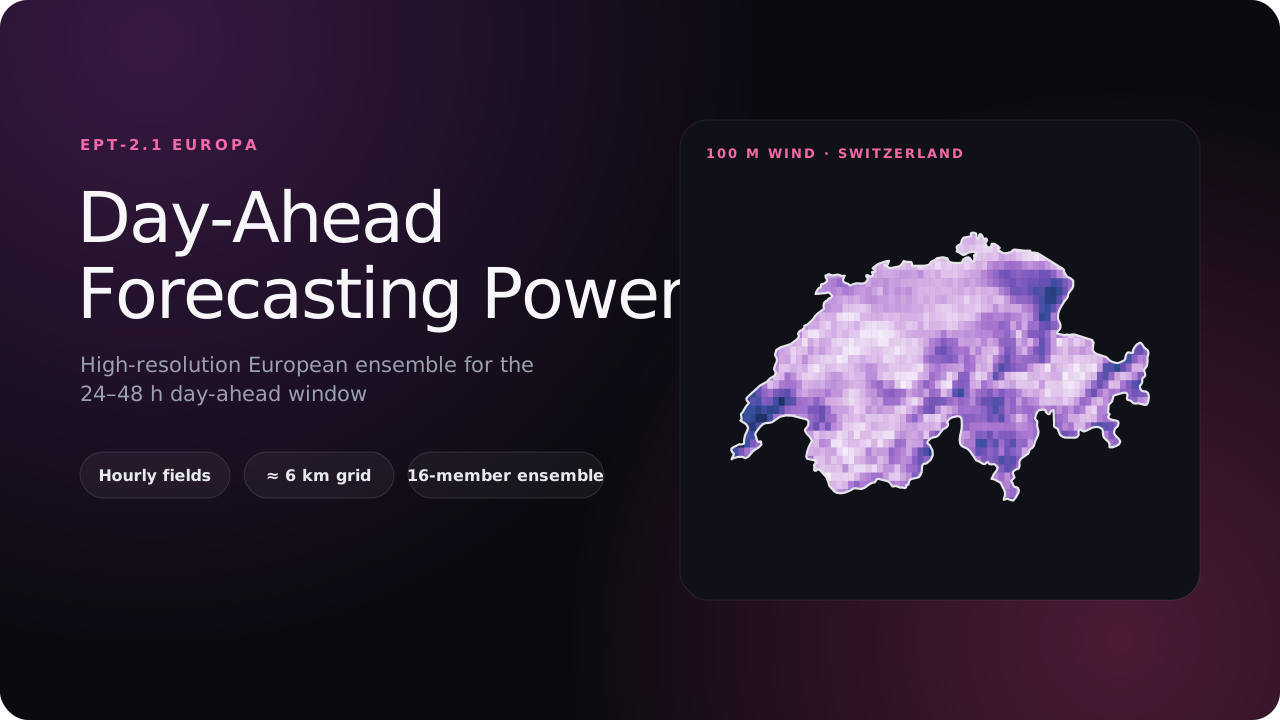
European power traders make day-ahead decisions while the forecast for tomorrow is still evolving. EPT-2.1 Europa is Jua's high-resolution ensemble forecast for Europe, built around that operating reality: a newly initialized forecast every hour, approximately 6 km detail, 16 ensemble members, and leading forecast skill across the 24–48 hour window that shapes many day-ahead decisions.
Built for European day-ahead decisions
Global weather models capture the large-scale atmosphere, but their grids smooth over local features that can move European wind and solar production. Regional numerical models resolve more of that structure, but their updates are still tied to fixed production cycles and can take hours to reach users. AI-driven forecasting makes a different operating model possible: frequent, high-resolution forecasts without waiting for the next conventional regional model cycle.
Europa produces a newly initialized forecast every hour, with a target dissemination time of two hours after initialization. For a trader, the benefit is practical. As the atmosphere changes and tomorrow's delivery period approaches, a recent forecast can replace an older view without waiting for a six-hourly update cycle.
The model provides hourly fields out to 48 hours, including solar radiation and wind speed from 10 to 200 m above ground. Its 16 ensemble members support uncertainty-aware decisions across day-ahead auctions, intraday re-forecasting, renewable scheduling, and imbalance-risk management.
Best performance for day-ahead trading
We evaluated Europa's ensemble mean against weather-station observations and compared it with DWD ICON-EU, ECMWF IFS, and Jua EPT-2. The evaluation covers 6 February through 30 June 2026 across 17 European countries, using the same available initialization days and 00, 06, 12, and 18 UTC cycles for every model. We apply a trailing four-week debiasing and report hourly mean absolute error (MAE) from 6 to 48 hours for wind, solar radiation, and temperature.
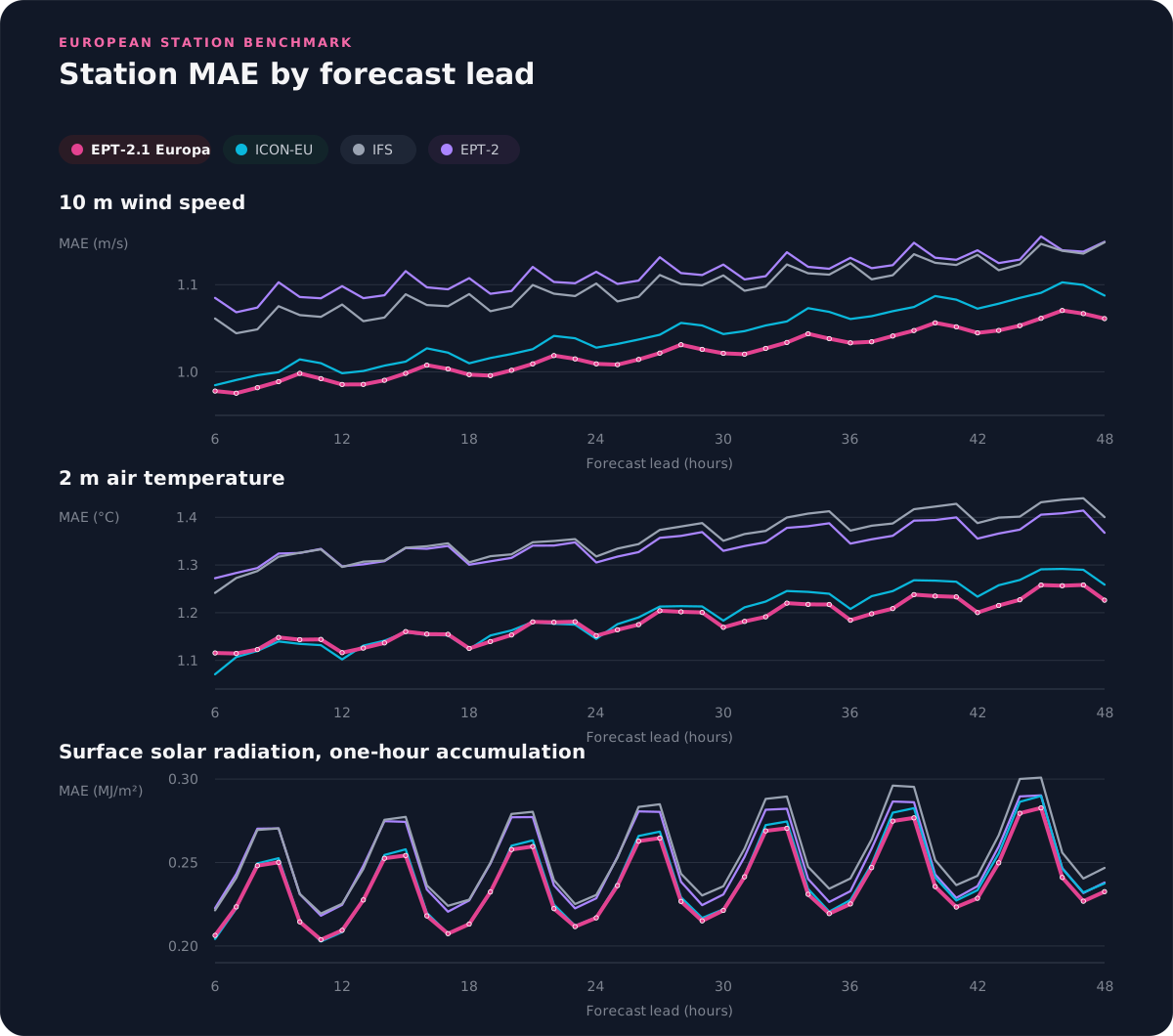 Station MAE at every hourly checkpoint from 6–48h. The 17-country set covers Austria, Belgium, Switzerland, Czechia, Germany, Denmark, Estonia, Spain, Finland, France, Hungary, Italy, the Netherlands, Norway, Romania, Sweden, and Slovenia. Evaluation period: 6 February–30 June 2026. Lower is better.
Wind leads across the entire forecast. Europa records the lowest 10 m wind-speed MAE at every hour from 6 to 48. Its pooled MAE is 2.2% below ICON-EU, 7.0% below IFS, and 8.2% below EPT-2. The result is consistent across the curve, including every hour in the 24–48 hour day-ahead window.
Temperature takes the lead as day-ahead trading begins. ICON-EU and Europa alternate at shorter leads. From 25 through 48 hours, Europa records the lowest 2 m temperature MAE at every hour. Across the complete 6–48 hour range, its pooled MAE is 1.1% below ICON-EU, 12.1% below EPT-2, and 13.1% below IFS.
Solar leads before the day-ahead window opens. After the models alternate at early leads, Europa records the lowest one-hour accumulated solar-radiation MAE at every hour from 20 through 48. Its pooled 6–48 hour MAE is 1.0% below ICON-EU, 5.2% below EPT-2, and 6.8% below IFS. The lead is already established by hour 24 and continues through the full day-ahead window.
Across wind, solar radiation, and temperature, Europa is the best-performing model at every hourly checkpoint from 25 to 48 hours. That gives traders one consistent day-ahead forecast across the weather variables that drive renewable production and demand.
High-resolution detail with leading forecast skill
Resolution matters when it is paired with accuracy. Europa combines the station-verified performance above with an approximately 6 km grid that represents more of Europe's local weather structure.
Switzerland shows the increase in detail. In the matched forecast below, AIFS has 171 native grid points inside the displayed bounding box; Europa has 2,765. Initialization, valid time, lead, variable, extent, and color scale are identical.
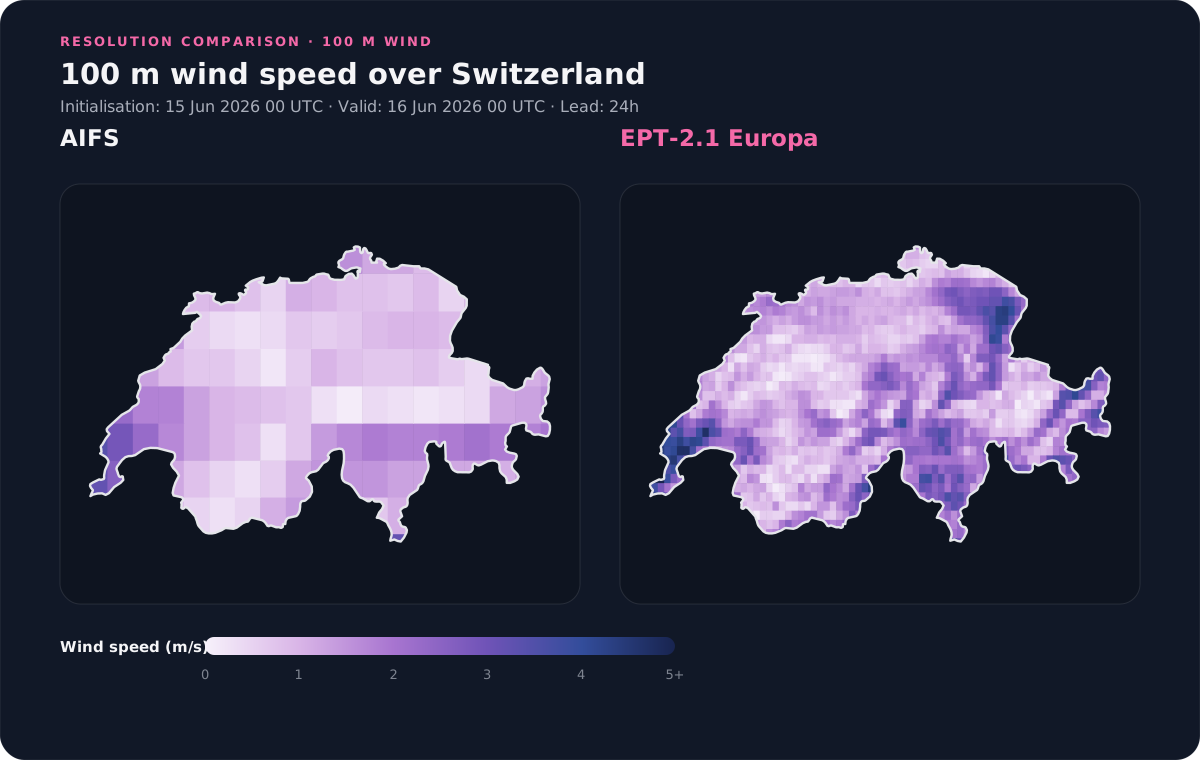 100 m wind speed initialized 15 June 2026 at 00 UTC and valid 16 June 2026 at 00 UTC. AIFS is the deterministic forecast on its native 720×1,440 global grid; Europa is ensemble member 0 (
ept2_1_europa_0) on its native 553×961 European-domain grid. The continuous 0–5+ m/s color scale and displayed extent are identical. Switzerland boundary: Natural Earth.
The greater grid-point density represents sharper spatial gradients across Alpine terrain, while the station benchmarks establish that Europa also delivers leading forecast accuracy. Europa brings local structure, forecast skill, and hourly availability together in one European model.
Case study: Europa leads Dutch wind-power forecasting
The station results show Europa's day-ahead wind advantage across Europe. The Dutch onshore wind benchmark tests that advantage against the quantity traded in power markets: megawatts.
Each model's wind forecast passes through the same installed-capacity-weighted physical conversion and is compared with TSO-reported actual generation. The benchmark uses a common forecast cohort, applies a trailing four-week MW debiasing using only prior data, and excludes negative day-ahead-price intervals, when curtailment can make metered production an unreliable measure of weather-forecast skill.
For the fully warmed-up 6 March–30 June 2026 cohort, we pool every common 15-minute MTU across the 24–48h window.
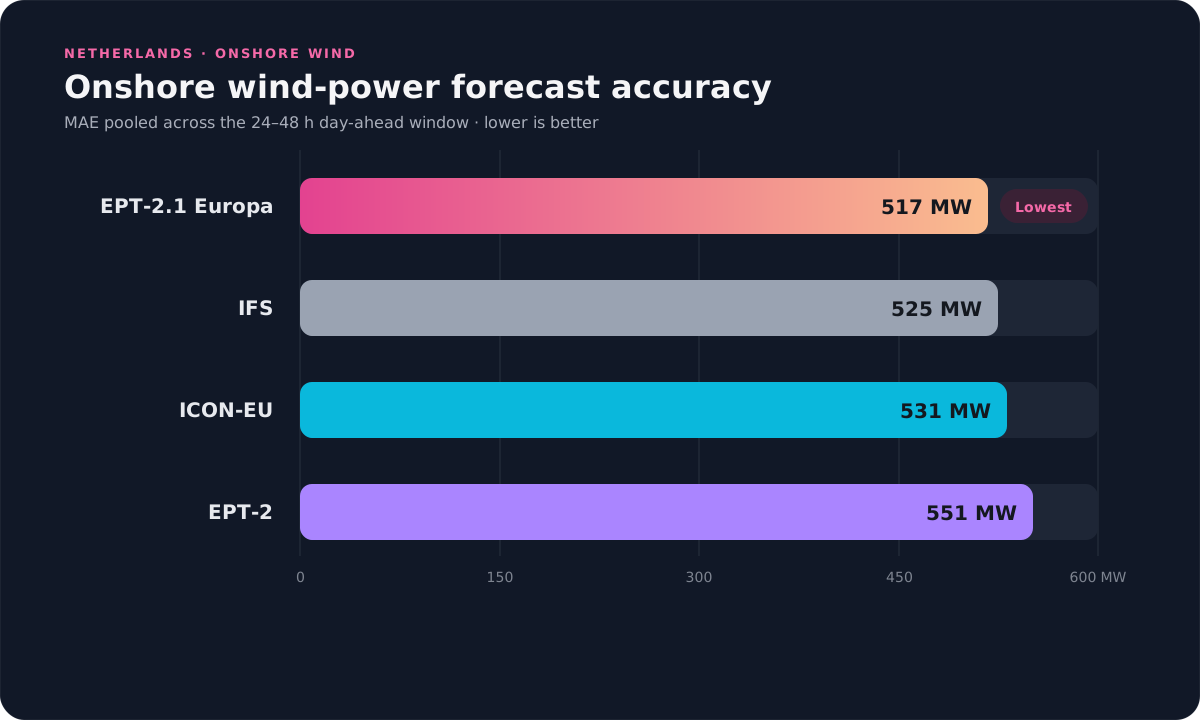 Netherlands onshore wind-power MAE pooled across common 15-minute MTUs from 24–48h. Fully warmed trailing-bias cohort, 6 March–30 June 2026; common forecast days and cycles; negative-price intervals excluded. Lower is better.
Europa's pooled error is 517 MW, 1.4% below IFS, 2.6% below ICON-EU, and 6.1% below EPT-2.
Across the full Dutch day-ahead window, Europa records the lowest onshore wind-power error. Its advantage remains visible after capacity weighting, physical conversion, debiasing, and comparison with actual fleet output. The forecast-skill lead reaches the market variable a trader ultimately manages.
Europa at a glance
- A newly initialized forecast every hour
- Target dissemination time of two hours after initialization
- Hourly forecast fields out to 48 hours
- Approximately 6 km European resolution
- 16 ensemble members
- Solar radiation and wind speed from 10 to 200 m above ground
- Historical archive for backtesting from August 2025
- Available through the Jua Platform, REST API, and Python SDK
EPT-2.1 Europa is available now for European weather and power forecasting.
Evaluation notes
Station results use ensemble means, MAE, a common initialization-day intersection, 00/06/12/18 UTC runs, and a trailing four-week debiasing. The 17-country aggregate covers Austria, Belgium, Switzerland, Czechia, Germany, Denmark, Estonia, Spain, Finland, France, Hungary, Italy, the Netherlands, Norway, Romania, Sweden, and Slovenia. Solar stations are quality-audited; the solar metric scores one-hour accumulated radiation at hourly forecast leads.