Solar forecasting has traditionally involved a trade-off. Nowcasts respond quickly to changing clouds but do not extend far enough for day-ahead decisions. Conventional weather forecasts reach further ahead, but their initial conditions may already be hours old by the time they are available. For solar, those missing hours are often when broken cloud rearranges the irradiance field that drives generation.
Today, we are introducing EPT-2.1 Helios, a European solar forecasting model designed to close that gap. Initialized with real-time satellite observations, it produces a 48-hour forecast every 30 minutes, with fields at 30-minute resolution. Intraday users get a fresh view as clouds evolve; day-ahead users get a forecast that is available before the auction gate and still covers the following day’s production.
From Observation to Forecast
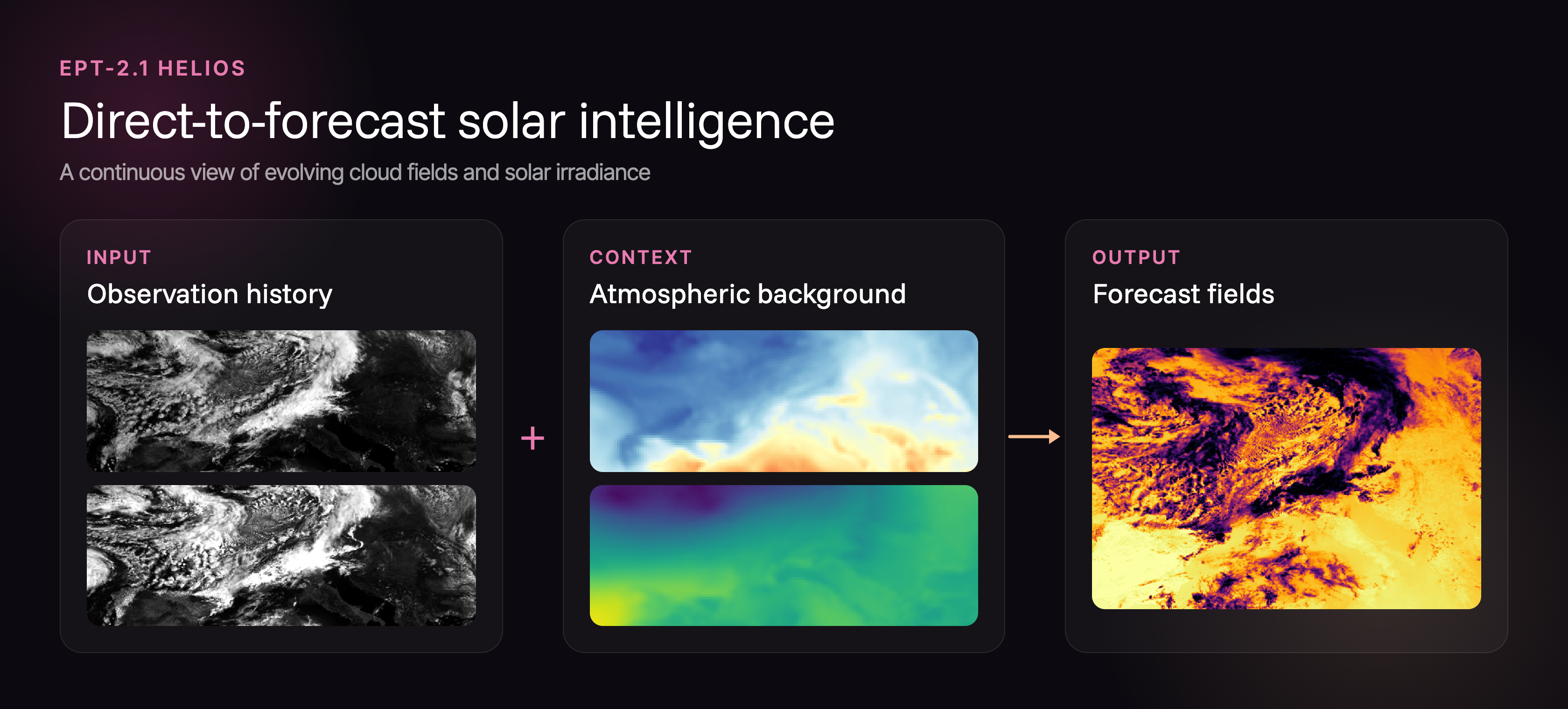
Traditional solar forecasts inherit their initial conditions from a numerical weather prediction (NWP) analysis cycle. By the time that analysis is finished and the forecast is disseminated, the cloud field it describes can already be several hours out of date. Helios skips the intermediate analysis. It initializes directly from recent satellite observations, so each run starts from the clouds that are actually overhead rather than from an older reconstructed state.
At every cycle, Helios combines a short history of satellite imagery (typically 20–30 minutes old, due to satellite latency) with atmospheric background fields, then predicts solar-radiation fields for the next 48 hours. A new cycle starts 30 minutes later with updated observations.
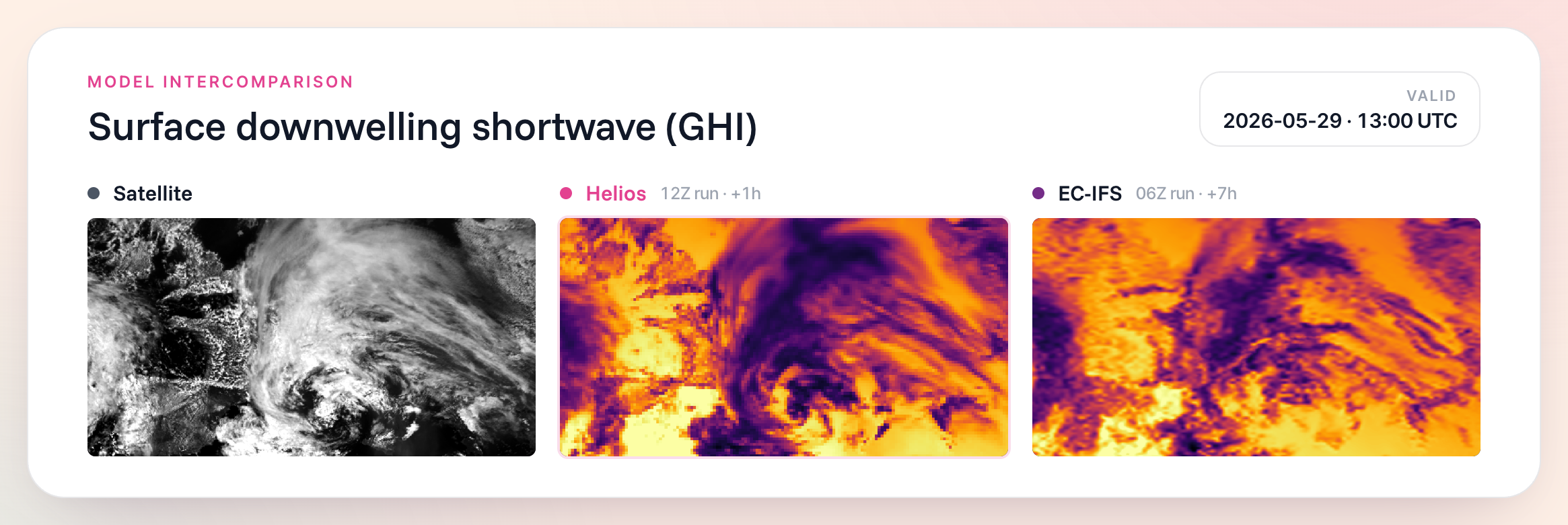
That difference shows up clearly in the irradiance field. The figure below shows the same valid time (13:00 UTC on 29 May 2026), with a satellite image for reference together with each model’s latest available run: Helios from its 12:00 UTC cycle and EC IFS from its 06:00 UTC cycle. Helios tracks the observed cloud structure more closely, including the cyclonic swirl and sharper clear/cloudy contrasts, while EC IFS loses more of that local detail. For solar.
Does the Fresher Forecast Improve Accuracy?
We evaluated Helios against observations from approximately 500 stations across key European market zones, including Germany, France, Belgium, the Netherlands, Austria, Denmark, Finland, and neighbouring regions. The comparison spans lead times from 1 to 48 hours and benchmarks Helios against DWD ICON-EU, a regional NWP model, and ECMWF IFS, a global NWP model.
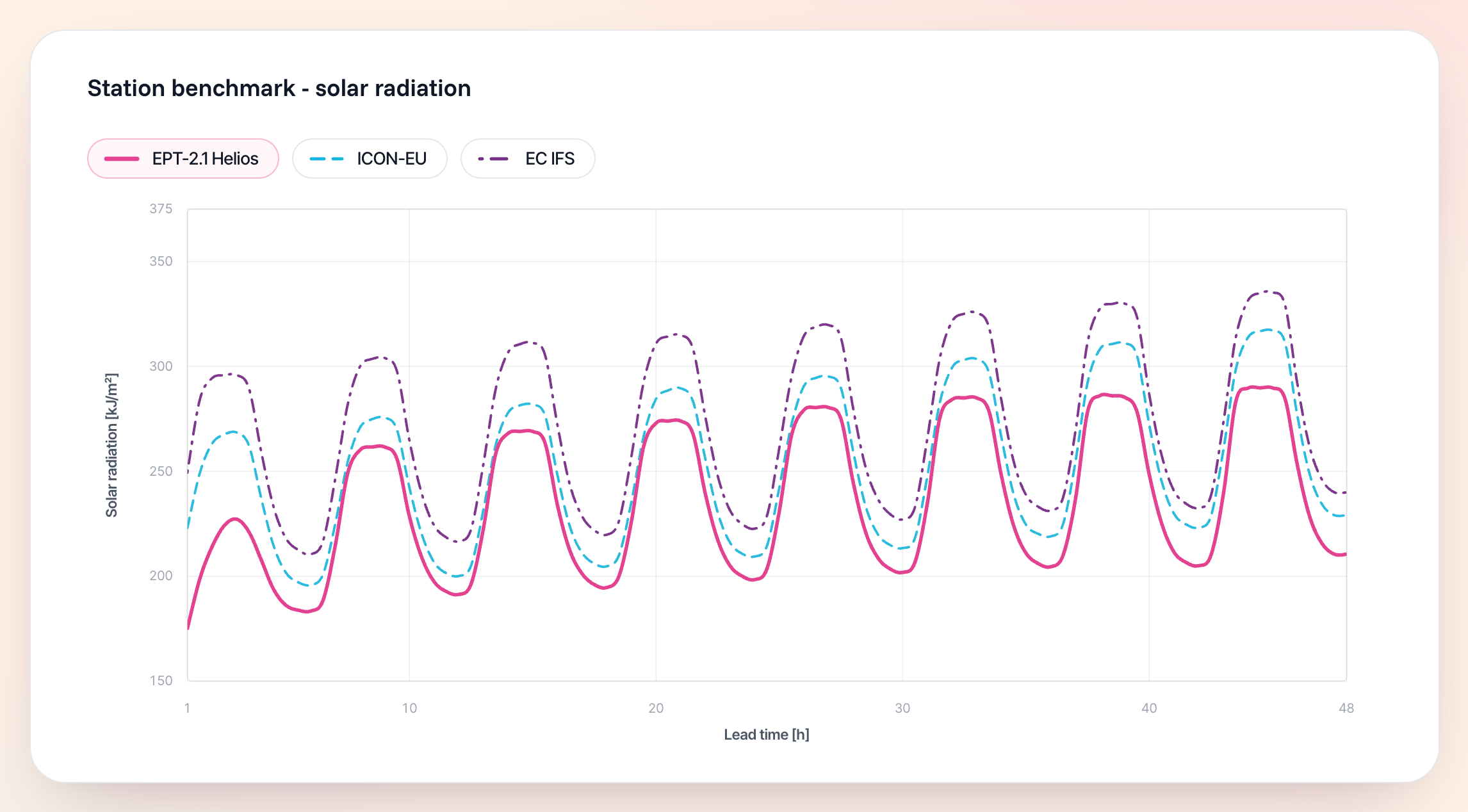
The station benchmark uses all days from December 2025 through mid-July 2026, at common initialisation times of 00, 06, 12, and 18 UTC. Those are the EC IFS cycles, so every model is scored from the same init times. This does not credit Helios’s operational update advantage: in live use, Helios can be up to about 6 hours earlier than EC IFS and 4 hours earlier than ICON-EU.
The chart below shows mean absolute error (MAE) in surface solar radiation by forecast lead time. Error follows the diurnal cycle: it rises through daytime peaks, when irradiance and cloud-driven uncertainty are highest, and falls at night. Across that cycle, Helios has lower MAE than both baselines at every lead time from 1 to 48 hours.
The gap is largest in the first few hours, where satellite initialization matters most. Across most lead times, Helios’s MAE is roughly 10–20% lower than ICON-EU and 15–35% lower than EC IFS, with the strongest separation near the first daytime peak. Later peaks remain cleaner as well: Helios stays well below IFS through day two and continues to beat ICON-EU even as all three curves rise with lead time. The fresher start is not only a nowcasting advantage; it reduces error when solar production are largest.
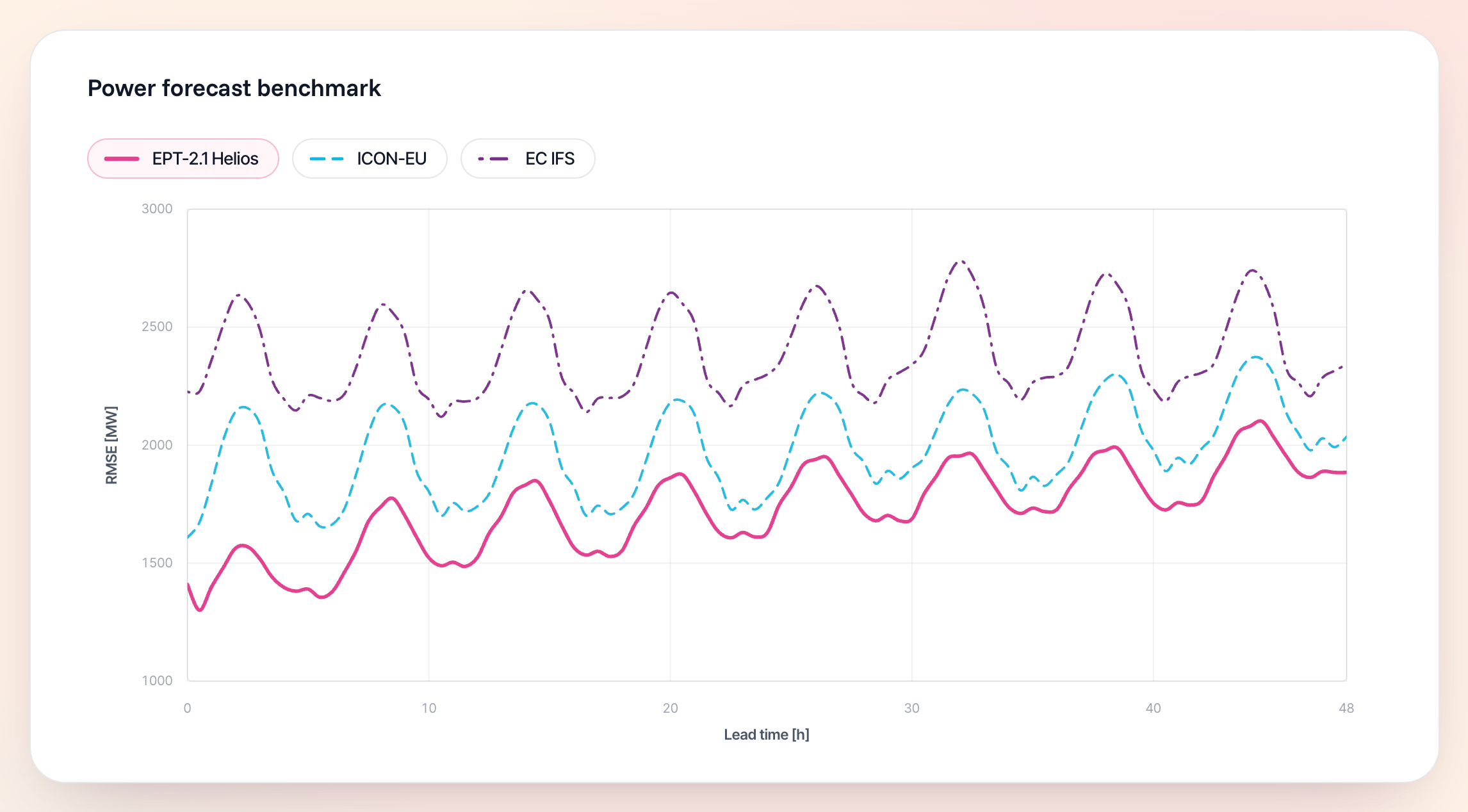
We also evaluate a German solar-power forecast built from the same radiation fields, over the same period and init times. The mapping is physics-based: the average of surface solar radiation downwards (SSRD) at solar-farm locations, weighted by each farm’s installed capacity. Because this translation does not include curtailment or other market interventions, we compare against TSO-reported actual generation and exclude intervals where production was curtailed. On that filtered set, Helios has the lowest RMSE at every lead time from 1 to 48 hours. Over the first 6–12 hours, power RMSE is roughly 20–25% lower than ICON-EU and 35–40% lower than EC IFS, a larger relative gain than at the station level, consistent with capacity weighting concentrating the evaluation where installed solar, and therefore cloud error, matters most for the fleet.
What That Accuracy Means at the Auction Gate
Lower RMSE is useful only if it improves the decision that actually settles. For day-ahead solar, that decision is the volume sold before the auction gate, later settled against realised generation at the imbalance price. To quantify the commercial cost of forecast error, we modelled a German solar farm with 10 MW of maximum capacity from January through July 2026.
For each settlement interval, we:
- Sell the forecast volume in the day-ahead market.
- Settle any difference between forecast and actual generation at the imbalance price.
- Compare the resulting revenue with what the asset would have earned with a perfect forecast.
The calculation is:
Here, is forecast generation, is actual generation, is the day-ahead price, and is the imbalance price. We use the latest forecast run available before Germany’s 12:00 local-time (CET/CEST) auction gate and exclude intervals with negative prices. We report the absolute value of the resulting revenue difference as revenue regret; lower is better.
| Model | Latest run available before the gate | DA revenue regret |
|---|---|---|
| EPT-2.1 Helios | 09:30 UTC run | €3,879.65 |
| ICON-EU | 06:00 UTC run | €5,811.75 |
| EC IFS | 00:00 UTC run | €6,313.93 |
In this analysis, Helios reduces day-ahead revenue regret by roughly 33% versus ICON-EU and 39% versus EC IFS. Part of that gap is accuracy; part is timing. Helios’s 09:30 UTC run is available before the gate, while the latest ICON-EU and EC IFS runs in the comparison are from 06:00 UTC and 00:00 UTC. The day-ahead bid therefore sees both a more recent atmospheric state and a lower-error forecast, the same combination the station and power benchmarks measure across the horizon.
Helios is available through the Jua Earth Intelligence Platform, with real-time 30-minute updates, a 48-hour horizon, and a historical archive for backtesting. It is accessible through the REST API and Python SDK and is compatible with existing EPT-2 family workflows.
For parameters and API access, see our documentation.